Why is SAHARA pumping
The move looks driven by product shipping, the 2026 agentic AI roadmap, and the Danal Fintech partnership angle, not just random meme flow.
The catch: a March 26 unlock, a much larger June cliff event, and futures volume far bigger than spot mean chasing green candles is still dangerous.

1. Why is SAHARA pumping today? Catalysts and the real bull case
Why is SAHARA pumping in the first place? Let’s break this down. This is not a broad alt season move where everything with a ticker gets a bid. Bitcoin is still hovering in the low $70K area, BTC dominance is above 63%, and the alt season index is only 26. That means today’s SAHARA move looks much more like a single-name narrative trade than a market-wide altcoin party.
And honestly, that matters. When a coin rips in a weak alt backdrop, the move usually has to be backed by something real. In SAHARA’s case, the story is product plus narrative plus distribution. Sahara AI’s official 2026 roadmap laid out the shift toward B2B2C, consumer-facing products, Sorin, ClawApp, and an eventual Agentic AppChain. That’s not vague “AI will be big” fluff. That’s an actual roadmap the market can price.
Then came the Sorin beta update, which shipped in-chat price charts, slash commands, portfolio tracking, and hybrid routing. Here’s the kicker: crypto loves a good story, but it pays up faster when the story turns into a shipped product. That’s exactly what happened here. The tone shifted from “coming soon” to “already live.”
There’s also a South Korea angle that traders should not ignore. The Danal Fintech partnership opens a pretty clean narrative bridge into real consumer finance rails and potential Paycoin app integrations. That makes the token feel less like a generic AI badge and more like an AI-fintech infrastructure bet. Pair that with the project’s official X account, its Binance spot market, and its Bybit spot market, and you’ve got a move that looks globally recognized, not locally fabricated.
Smart money is moving because all three exchanges are showing strength at the same time. That’s the kind of alignment you want to see. Not one venue. Not one random wick. A synchronized bid across Upbit, Binance, and Bybit. That’s usually when a breakout deserves respect.
2. Whale cost basis and on-chain flow
No one can honestly pin down the exact average cost basis of every whale wallet in real time. But you can still map where size likely got absorbed. On today’s structure, the cleanest reload zone looks like $0.0217 to $0.0223, which lines up with roughly 32 to 33 KRW. Binance’s 24-hour low came in around $0.02178, and Upbit’s low zone was around 32.0 KRW. Price probed that pocket and failed to stay below it. That’s usually not random.
The on-chain flow is actually pretty interesting. CoinGecko’s holder-flow snapshot showed negative CEX net flow over the last 24 hours. In plain English, more SAHARA left centralized exchanges than entered them. That leans more toward absorption and positioning than spot distribution. Upbit premium staying slightly negative helps too. This wasn’t a classic frothy Korea-only blowoff.
Now the part that should keep you honest: the derivatives layer is much hotter than the spot tape. Coinglass showed roughly $66.7M in spot turnover versus about $302.0M in futures turnover. So yes, there’s evidence of real interest, but there’s also leverage all over this trade. Translation: whales may be accumulating, but they’re not doing it in a clean, low-volatility vacuum. Fast money is absolutely riding shotgun.
And one more thing traders tend to forget: overhead supply can come back when you least expect it. Back in January, a dormant whale moved 150M SAHARA to Binance after months of inactivity. That kind of history matters. It tells you this chart can attract sudden supply if old holders decide this bounce is their exit. So I read the setup like this: smart money is defending the lower band, but the market is still carrying enough leverage and legacy supply risk that you do not want to treat this as a free ride.
3. “Should you chase it now?” Why is SAHARA pumping, RSI heat, and entry risk
This is where people get sloppy. A lot of traders see a clean pump and assume the coin must already be insanely overbought. That’s not really the case here. Upbit’s technical snapshot put RSI around 54, and the 4-hour RSI read is roughly 56.38. So on paper, this is not a full-blown RSI euphoria event yet. That means the chart still has room to stretch if buyers keep pressing.
But RSI is not the whole game. The quality of the volume matters more than the headline candle. Futures volume is dramatically larger than spot volume right now. That tells you part of the move is being accelerated by leveraged positioning, not just clean spot accumulation. When that happens, price can overshoot hard and then punish late entries just as fast.
There’s also tokenomics risk sitting right in front of the tape. The next unlock lands on March 26 and releases 132.93M SAHARA, about 1.3% of total supply. That’s manageable, but it still matters because the unlocked buckets include airdrops, community incentives, and ecosystem development. That’s the kind of supply that can lean on price if sentiment cools off even a little.
And the bigger trap is further out. Only about 29% of supply is unlocked today, which means dilution is still a live issue. The official tokenomics structure uses a one-year cliff for key insiders and backers, followed by monthly vesting. That leaves a much larger cliff event hanging over June 26. In other words, even if the project is executing, the token still carries a supply overhang. That’s a classic case where great fundamentals and messy token mechanics can coexist.
So should you chase? You can, but you need to know what you’re paying for. This is not a dead chart. It’s not a random pump either. But it is a leverage-heavy setup with unlock risk nearby. That means buying strength without a plan is just donating to better entries that came before you.
4. 🎯 Kevin’s realistic take-profit plan (4H + 1D)
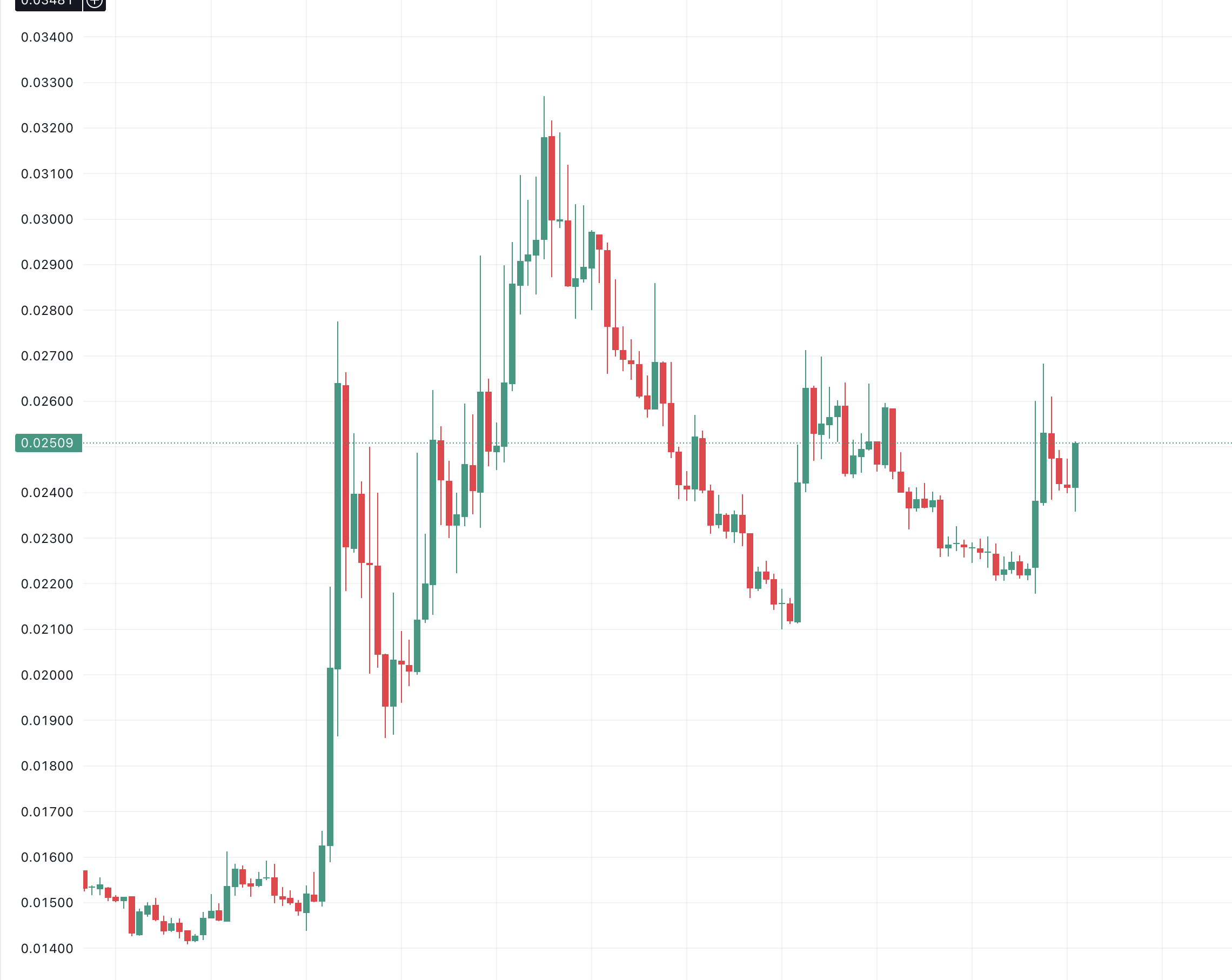
Now for the part everybody really wants: the exits. I’m using the 4-hour chart for tactical trading and the daily chart for the swing extension. The first obvious take-profit zone is around $0.0263. That area lines up with today’s high and the recent 7-day ceiling. In fast pumps, the first retest of fresh highs is where momentum traders usually start ringing the register.
That’s why TP1 matters. Not because it’s magical, but because it’s the most crowded short-term decision point on the board. If SAHARA gets a clean 4-hour close above $0.0263 with real follow-through, then the trade shifts from scalp mode to expansion mode. That opens the door to TP2 near $0.0295, basically the front edge of the psychological $0.03 wall.
Here’s how I’d handle it in real life. If I’m already long from lower, I’m trimming 25% to 35% into TP1. No hero stuff. No “all or nothing” nonsense. Then I let the remaining size work toward TP2 only if momentum stays healthy. That way I’m paid even if the move stalls, but I still keep upside exposure if the breakout turns into a squeeze.
If you’re flat right now, this is where discipline matters. Buying directly under resistance is how traders turn a good thesis into a bad trade. Better to wait for a pullback, or wait for a confirmed breakout and retest. Missing the first leg hurts your ego. Buying a bad entry hurts your P&L.
5. Defense zones and stop-loss if momentum fades
On the downside, I’d map this in layers. First support is the mid-pullback band around $0.0223 to $0.0225. If buyers defend that quickly, the move still looks healthy. The real line in the sand, though, is $0.0218. That’s the area where today’s structure actually proved buyers were willing to step in.
If price starts living below that zone, the setup changes fast. My practical invalidation is a 4-hour close below roughly $0.0210, and for conservative traders, a daily close under that neighborhood is the cleaner stop. Why there? Because once the market loses the recent low cluster and fails to reclaim it, this stops being a breakout pullback and starts looking like a failed expansion.
One more trick that helps: if SAHARA breaks above $0.0263 and later comes back down, watch whether the old resistance flips into support. That retest is gold. Hold it, and TP2 stays alive. Lose it, and the move starts looking tired. In crypto, the most expensive thing on earth isn’t lack of information. It’s refusing to admit your trade structure changed.
FAQ
Why is SAHARA pumping today?
The move looks driven by project-specific catalysts: the 2026 roadmap, Sorin beta feature shipping, and the Danal Fintech partnership narrative, all landing in a market that is not broadly rewarding every altcoin.
Is SAHARA already overbought?
Not in classic RSI terms. The 4H RSI is still in neutral territory. The bigger issue is leverage, not just RSI, because futures volume is much larger than spot volume.
When is the next token unlock?
The next scheduled unlock is March 26, with a more important larger cliff event still hanging out in June. That makes token supply one of the main risks traders should respect.
What invalidates the bullish setup?
Losing the $0.0218 support and then closing a 4H candle below about $0.0210 would seriously weaken the short-term bull case. At that point, the breakout thesis needs to be reevaluated.